

Skip to content

How Xanterra unified 7 travel brands on HubSpot to power smarter, scalable marketing

Narrate this article
How Xanterra unified 7 travel brands on HubSpot to power smarter, scalable marketing
1:17
Automation Power

25+

Nurture Workflows
Platform Scope

7

Business Units
Legacy Retired

100%

Migration from RedPoint
Efficiency Increase

50%

Quicker email creation

Xanterra Travel Collection® manages a portfolio of seven travel and hospitality brands, each operating across different destinations, audiences, and seasonal cycles.

Prior to working with Engaging, these brands relied on a collection of disconnected legacy marketing platforms for email, data management, reporting, and asset storage. As complexity increased, this fragmented ecosystem limited visibility, slowed execution, and introduced operational risk.

Xanterra engaged Engaging to fully migrate its marketing operations to HubSpot, replacing legacy systems with a single, governed platform designed to support multi-brand execution, measurable performance, and long-term scalability.

The challenge:
fragmented systems could no longer support a growing multi-brand portfolio.

Marketing operations became fragmented as Xanterra scaled across seven distinct travel and hospitality brands. Each brand relied on separate legacy tools for email marketing, form capture, reporting, and file management, which worked in isolation but broke down as cross-brand coordination and visibility became critical.

Marketing data lived across disconnected systems, making it difficult to gain a consolidated view of contacts, engagement, and performance across the portfolio. The fragmented legacy setup also limited Xanterra’s ability to adopt more advanced automation and AI-driven optimisation, as clean, unified data and consistent workflows were not in place.

Problem 1:

Marketing operations were fragmented as Xanterra scaled across seven distinct travel and hospitality brands. Each brand relied on separate legacy tools which worked in isolation but broke down as cross-brand coordination and visibility became critical. Marketing data lived across disconnected systems, making it difficult to gain a consolidated view of contacts, engagement, and performance across the portfolio.

Problem 2:

Reporting and optimisation were hindered by the lack of a single source of truth. Insights required manual consolidation across platforms, slowing decision-making and increasing the risk of inconsistencies and errors. Without unified data and reporting, teams struggled to confidently measure campaign effectiveness, compare performance across brands, or quickly act on what was driving results.

Problem 3:

Operational inefficiencies increased as campaign volume and complexity grew. Creating and launching marketing emails was time-intensive, file management was decentralised, and teams spent considerable effort navigating between systems to execute routine work. These inefficiencies introduced operational risk and constrained the team’s ability to scale, improve consistency, and prepare for more advanced automation and AI-driven marketing, making a full migration away from legacy platforms necessary.

The solution:
A structured platform migration to replace legacy systems and centralise multi-brand marketing

Engaging approached Xanterra’s challenge through a structured platform migration strategy focused on retiring legacy systems, consolidating marketing operations, and enabling scalable execution across seven brands. The solution centred on migrating all marketing activity into HubSpot Marketing Hub Enterprise, supported by Operations Hub and a tightly integrated data layer via Segment.


Our focus was on creating a single source of truth for contacts, campaigns, assets, and reporting, while improving operational efficiency, reducing manual effort, and preparing the organisation for more advanced automation and AI-driven marketing.


The solution was designed not only to replace legacy platforms, but to create a data and automation foundation capable of supporting AI-assisted personalisation, optimisation, and future intelligent engagement.

The Strategic Plan
The Implementation
The process
  1. Audited existing platforms including RedPoint, Kentico, WordPress forms, and standalone file management systems
  2. Defined clear migration boundaries to fully decommission legacy email, form, and asset tools
  3. Scoped data types, campaign dependencies, and reporting requirements across all brands
Legacy platform retirement and scope definition
The process
  1. Audited existing platforms including RedPoint, Kentico, WordPress forms, and standalone file management systems
  2. Defined clear migration boundaries to fully decommission legacy email, form, and asset tools
  3. Scoped data types, campaign dependencies, and reporting requirements across all brands
Multi-brand HubSpot architecture
The process
  1. Implemented HubSpot Marketing Hub Enterprise with seven fully branded business units
  2. Configured brand-specific domains, email identities, and subscription centers
  3. Designed permissioning and governance models to balance autonomy with central oversight
Data standardisation and integration
The process
  1. Standardised contact properties, lifecycle stages, and segmentation logic across brands
  2. Integrated Segment CDP to enable identity resolution, lifecycle event tracking, and bi-directional data sync
  3. Scoped and configured custom objects to support bookings, packages, and upsell triggers
  4. Established clean, standardised data structures to support AI-assisted segmentation, optimisation, and predictive automation as capabilities mature
Campaign execution and automation
The process
  1. Rebuilt marketing email programs using HubSpot email, templates, and workflows
  2. Implemented lifecycle-based nurture journeys and behavioural automation
  3. Replaced external and CMS-based forms with HubSpot forms to improve data quality and conversion tracking
Reporting, enablement, and scalability
The process
  1. Built custom dashboards to provide real-time, cross-brand visibility into performance
  2. Centralized file management using HubSpot’s native file manager to eliminate duplication
  3. Delivered tailored training and enablement to support long-term adoption and independence
  4. Implemented consolidated dashboards to support faster insight generation and AI-assisted performance analysis over time
The Implementation


The implementation began with detailed discovery workshops involving each of Xanterra’s business units. These sessions surfaced segmentation needs, campaign goals, reporting requirements, and data flow dependencies across teams. Insights from discovery directly informed the HubSpot architecture and migration sequencing, ensuring the platform reflected real operational needs rather than a one-size-fits-all setup.

With discovery complete, Engaging moved into the platform build phase, configuring seven fully branded business units within a single HubSpot instance, each with its own domains, email identities, and subscription centres. In parallel, legacy systems including RedPoint, Kentico, and WordPress-based forms were fully retired, simplifying the martech stack and reducing ongoing maintenance overhead.

To support a unified customer view, Engaging collaborated with McGaw to implement a bi-directional integration between HubSpot and Segment. This enabled real-time identity resolution, lifecycle tracking, and consistent segmentation across platforms. Custom objects were configured to manage booking data, travel packages, and upsell triggers, establishing a foundation for future sales enablement, loyalty initiatives, and AI-driven personalisation.

Operational efficiency was a key focus throughout implementation. By rebuilding email templates, workflows, and asset management natively within HubSpot, the marketing team reduced the time required to create and launch marketing emails by 50%. Centralizing files within HubSpot’s file manager further improved collaboration and eliminated version control issues across brands.

To ensure adoption and long-term scalability, Engaging delivered tailored training sessions for each brand’s marketing team and implemented an IP warming strategy across all business units to protect deliverability and sender reputation from day one. This phased, discovery-led approach ensured the migration was executed with minimal disruption while delivering immediate operational gains and a future-ready foundation.

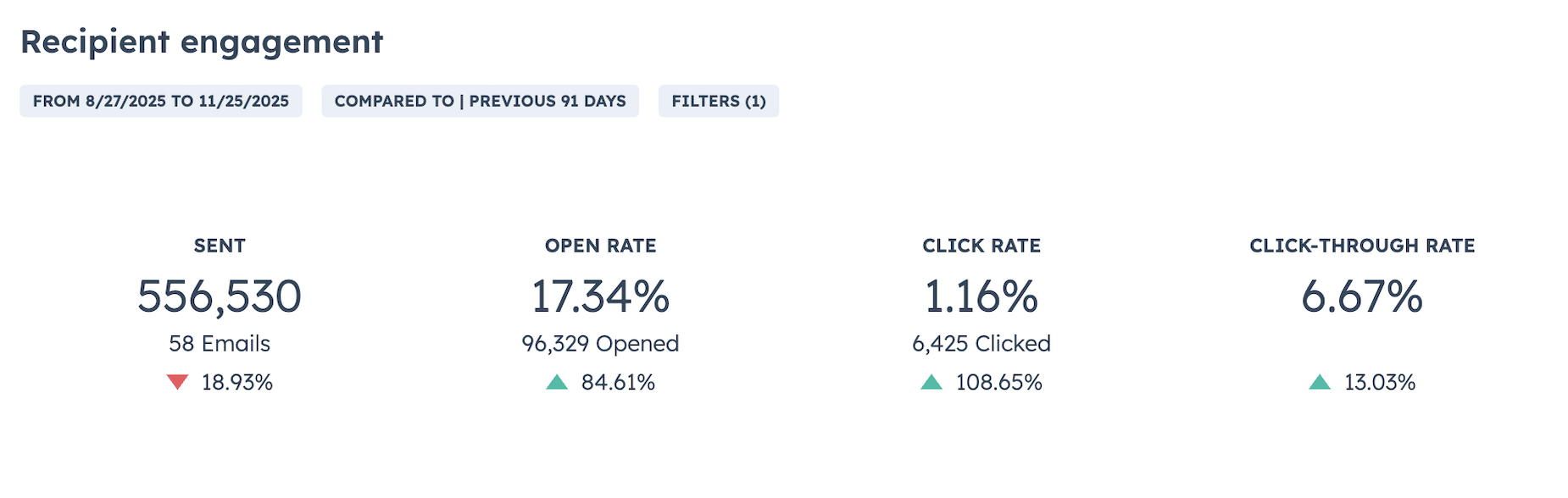
Screenshot 2025-12-15 at 12.16.21 pm

After implementation Xanterra saw a significant increase in their open and CTR rate, and the unified platform allowed for a streamlined approach to marketing communications. 

With unified data and standardised workflows in place, the HubSpot platform now supports AI-assisted decision-making, including faster insight generation from reporting, more intelligent segmentation, and a clear pathway to adopt AI-enabled engagement tools such as chat and advanced automation.


The impact and results

Following the migration to HubSpot, Xanterra achieved measurable improvements across marketing efficiency, performance, and visibility, while establishing a scalable foundation for cross-brand orchestration and future growth. By consolidating seven brands into a single, governed platform, marketing teams can now execute campaigns faster, measure results more accurately, and operate with greater confidence.

Operationally, the time required to create and launch marketing emails was reduced by 50%. Rebuilding email templates, workflows, and asset management natively within HubSpot eliminated manual handoffs and reduced reliance on external tools, enabling teams to respond more quickly to campaign opportunities and seasonal demands.

Performance improvements were also observed across lead capture and engagement. Newsletter form submissions increased by 2.24% when comparing April 1 to July 31 with July 31 to November 25, reflecting improved form strategy, cleaner data capture, and better alignment between campaigns and reporting.

Beyond efficiency and performance gains, the migration unlocked new strategic capabilities. Teams can now build and launch lifecycle-based nurture journeys without developer support, using modular templates and real-time behavioural data synced from Segment. This has increased agility and enabled deeper personalisation based on loyalty tier, trip type, and booking behaviour.

Cross-sell and upsell campaigns that were previously impractical are now fully achievable. Custom objects configured within HubSpot track booking data, travel packages, and upsell triggers, enabling more sophisticated targeting and coordinated campaigns across brands. Consolidated dashboards provide both marketing teams and leadership with a single source of truth, improving visibility into campaign performance and customer engagement.

Most importantly, the migration established a future-ready marketing foundation. With clean data, unified workflows, and scalable automation in place, Xanterra is positioned to expand lifecycle marketing, introduce sales integration, and further leverage HubSpot’s automation and AI capabilities, including intelligent engagement tools such as AI-enabled chat. What began as a platform migration now supports long-term, data-driven growth across the organisation.


Get in touch, We love to talk