


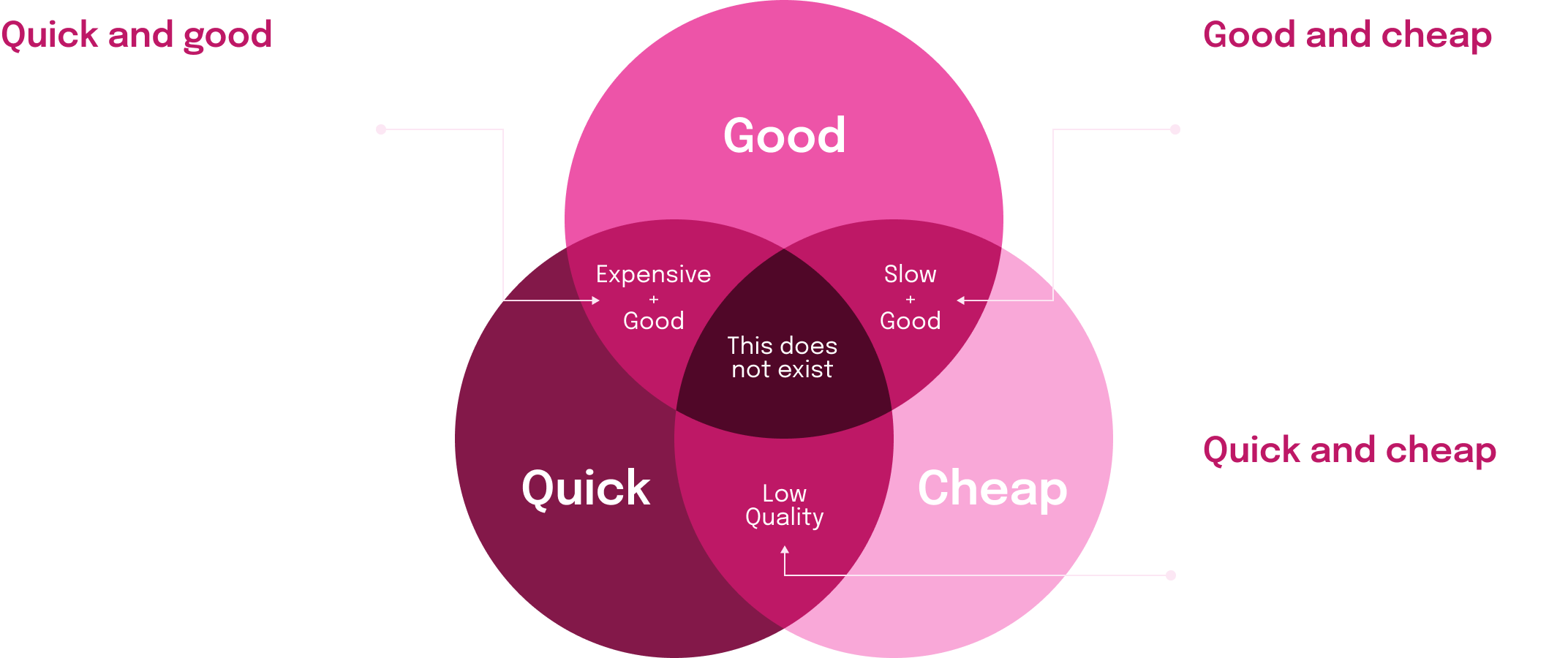
CRM onboarding projects come with an unavoidable trade-off: you can have it built well, built cheaply, or built quickly — but rarely can you get all three at once. Understanding which combination suits your organisation before the project starts is what separates implementations that deliver long-term value from ones that get rebuilt, and end up costing more time, money and resources in the long run. This concept is common across project delivery, design and software development work.
It is often summarised as Good, Cheap, Quick.
In the Venn diagram that represents this idea, the three qualities overlap in different combinations. You can achieve good and cheap, or good and quick, or cheap and quick. But at the very centre of the diagram sits a overlapping section labelled with a simple note:
This does not exist.
The principle is not meant to be cynical. It is simply a reminder that every project involves trade-offs, and attempting to optimise for all three variables at once usually creates problems somewhere else.
Yet when organisations begin conversations about CRM implementations or HubSpot onboarding projects, the discussion almost always starts with two familiar questions:
How fast can we do it?
And how much will it cost?
Those questions are understandable, but they rarely get to the heart of the issue. A more useful way to frame the conversation is to step back and ask a different set of questions entirely.
What is the cost of not doing this properly?
What happens if we push a system live too quickly?
Do we have a definition of what good is for our project?
Before timelines and budgets become the focus, the real challenge is defining what “good” actually means for your organisation. Without that clarity, comparisons between proposals, partners, and approaches become little more than a race to the lowest price or shortest delivery window.
And when it comes to CRM systems that underpin marketing, sales, and customer operations, those trade-offs have consequences that tend to surface long after the project has gone live.
The work involved behind a proper HubSpot implementation
From the outside, HubSpot onboarding and implementation can look deceptively simple. Import the contacts, build a few pipelines, connect some integrations, and start sending campaigns.
In reality, the work that determines whether the system succeeds or fails sits beneath the surface.
A proper implementation often includes:
- Data cleansing and structured migration from legacy systems
- Lifecycle stage design and pipeline alignment
- Integration architecture across multiple platforms
- Automation frameworks for marketing and sales teams
- Reporting structures leadership can actually trust
- Documentation, governance, and internal training
- Managing change for your people and their processes.
It’s not all glamorous work and snazzy automations. In fact, it is the not-so-sexy operational layer that modern systems rely on - clean data, clear documentation and definitions, reliable frameworks for automation.
These are also the foundations that AI tools rely on. AI cannot fix poor data structures or inconsistent processes. If anything, it accelerates the consequences of them.
When organisations skip this work to move faster, things can appear fine in the short term. Campaigns go out. Deals are created. Reports look busy.
But over time the cracks begin to show, and this is something we’ve seen from experience. Clients come to us for portal audits and rehab projects - they have a big, messy problem and they’re often a result of a project being implemented without the right foundations, people or systems in place.
Fixing these environments often requires rebuilding workflows, restructuring data models, cleaning data, and retraining teams. And the uncomfortable truth is that these projects often cost more than doing the implementation correctly the first time.
Why cheap and quick can become expensive later
When organisations are selecting an implementation partner, it is very easy for the conversation to collapse into a comparison of price and timelines. One proposal promises a faster delivery. Another appears cheaper. On paper the deliverables may look similar.
But what is often missing from that comparison is the depth of discovery and planning that sits behind the work. Lower-cost projects frequently involve reduced upfront analysis and limited system design. That can mean:
- Minimal discovery of business processes
- Limited data cleanup before migration
- Simplified integration planning
- Reduced documentation or internal training
The system may technically go live faster, but it is rarely aligned with how the business actually operates. Over time this leads to the same pattern → Teams lose confidence in the data, automation becomes fragile and leadership struggles to rely on reporting. Eventually someone says the words no one team wants to hear:
“Maybe we should rebuild this.”
At that point the organisation is effectively paying for the project twice.
Defining what “good” actually means
Before worrying about speed or cost, the most valuable exercise any organisation can undertake is defining what success actually looks like.
For some businesses, success might mean centralising fragmented systems into a single CRM. For others it might be reliable forecasting dashboards, better marketing attribution, or improved customer lifecycle visibility.
In more mature organisations, the goal may be enabling advanced automation, integrated data environments, or AI-assisted workflows.
These outcomes require deliberate design. They require an understanding of how teams operate today, and how the system should support them in the future.
Without that clarity, implementation conversations naturally drift toward timelines and budgets because they are the only measurable variables left. But once the organisation has defined what “good” means, the trade-offs become clearer.
The key to success: the foundation determines the outcome
HubSpot is an incredibly powerful platform. When implemented well, it becomes far more than a marketing tool. It becomes the operational centre for customer data, revenue reporting, automation, and increasingly AI-driven workflows.
But the value of that platform is determined far less by the speed of implementation than by the strength of the foundation beneath it.
The Good, Cheap, Quick diagram is not meant to discourage efficiency or careful budgeting. Every organisation has constraints, and every project involves trade-offs.
What the model highlights is a simple reality:
You cannot optimise for everything at once.
For most organisations undertaking a CRM transformation, the most sustainable path usually sits somewhere between good and deliberate. The upfront thinking, data preparation, and system design may take longer, but they dramatically reduce the technical debt that slows organisations down later.
Because when the foundations are right, everything that follows becomes easier.
-
Automation works.
-
Reporting can be trusted.
-
AI tools have clean data to learn from.
And the system that once looked like a project becomes what it was always meant to be: infrastructure for long-term growth.
As a HubSpot Elite Partner operating since 2009, and HubSpot's JAPAC Partner of the Year 2025, we've seen what strong foundations make possible — and what skipping them costs.
Not sure where to start? That's often the best place to begin the conversation. Tell us about your setup, your goals, or the problem you're trying to solve — and we'll help you work out the right next step.
Frequently Asked Questions
How long does a HubSpot CRM implementation take?
It depends on a few key variables: how many departments you're rolling out to at once, the complexity of your tech stack, whether you need custom integrations or can use out-of-the-box connectors, and whether there are live systems that need to stay running during the transition.
-
A single-department rollout with straightforward requirements can go live in under a month.
-
Multi-department implementations with custom integrations and no-downtime requirements take considerably longer.
-
Your internal resources matter just as much as your implementation partner's — teams that can dedicate time to discovery, testing, and sign-off move faster.
What does a proper HubSpot onboarding project include?
A thorough implementation starts with discovery, a clear understanding of your requirements, processes, and how your teams actually work. From there it moves into the build phase, followed by structured user testing and sign-off, and finishes with training so your people know how to use what's been built. Documentation and handover are part of it too. The projects that hold up over time are the ones where each phase gets the attention it needs, rather than being compressed to hit a deadline. As a HubSpot Elite Partner operating since 2009, we've guided hundreds of businesses through this process — we know what good looks like, and what to watch out for.
Why does a cheap CRM implementation often cost more in the long run?
Cheaper projects usually get there by cutting corners somewhere in the process — most often in discovery, data preparation, or training. When discovery is rushed, the system gets built around assumptions rather than how the business actually operates. When training is skipped, adoption suffers. These gaps tend to compound: teams lose confidence in the data, automations break, and reporting stops being reliable. Eventually the organisation faces a rebuild — and ends up paying for the project twice.
How do I know if my CRM needs a rebuild?
The clearest signs are that your team has stopped using it, it no longer reflects how your business operates, or your business has changed significantly since it was first set up. If you're not sure, it's worth getting a fresh set of eyes on it. We offer portal audits that give you an honest picture of what's working, what isn't, and whether a rebuild is actually necessary.
What is the difference between HubSpot onboarding and HubSpot implementation?
Implementation is the technical work: configuring the platform, building pipelines and workflows, connecting integrations, migrating data, and testing that everything functions correctly. Onboarding is what happens after — getting your people into the system, training them on how to use it effectively, and ensuring it actually gets adopted across the business. The two are closely linked, but they're distinct phases. Strong implementations that skip proper onboarding often struggle with adoption. The goal is both: a system that's built right and a team that's equipped to use it.