


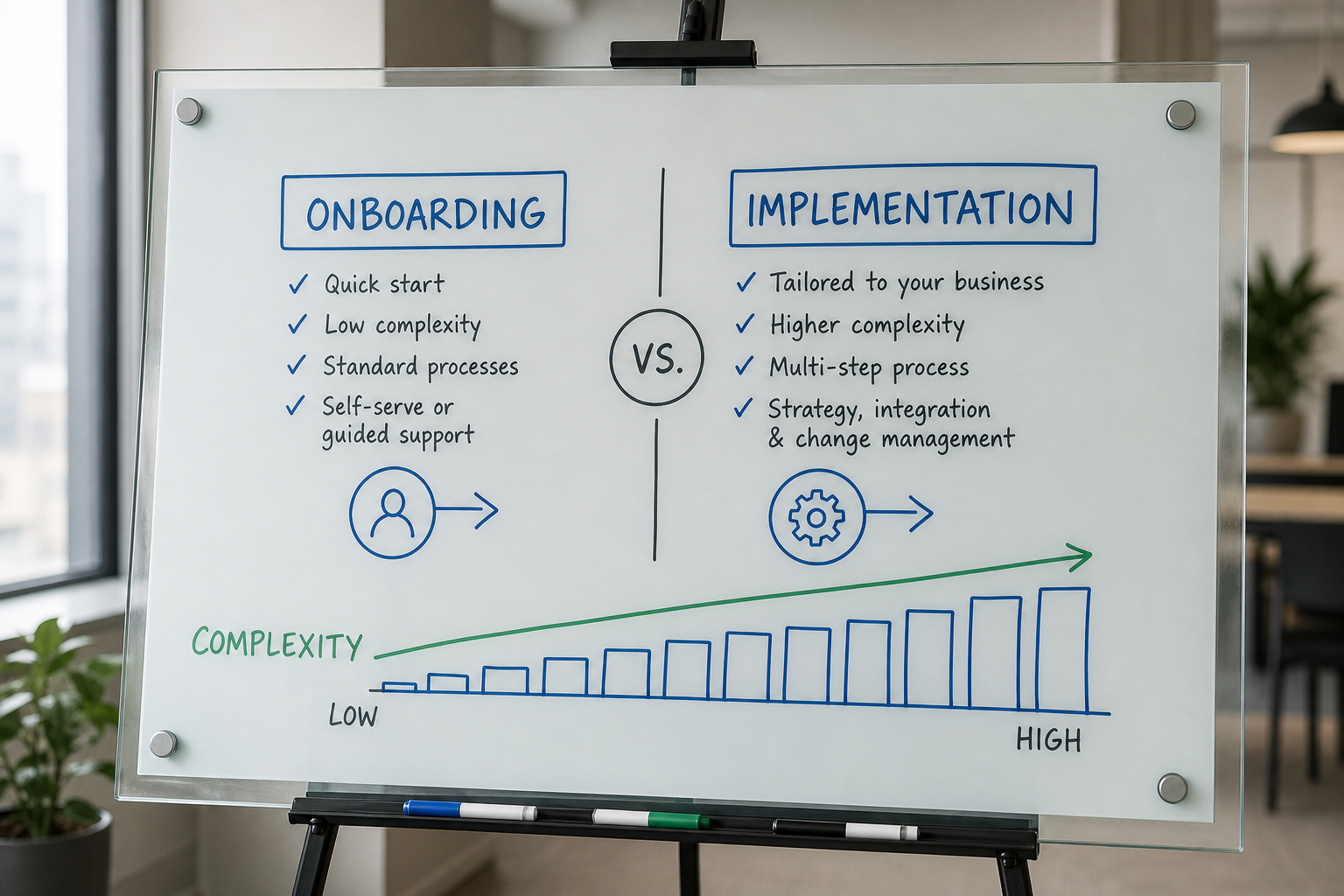
Plenty of US companies go through HubSpot's onboarding, get the platform running, and consider the job done. Then six months in, the gaps start showing: a system that doesn't talk to their billing platform, a sales process nobody actually follows, reporting that takes a spreadsheet to fix every month. The platform isn't the problem. What they went through wasn't really an implementation, it was a walkthrough.
Onboarding vs implementation
Onboarding gets you logged in and shown around. It often focuses on teaching the platform: where things live, how the tools work, and how to start using HubSpot day to day.
Implementation is different. It starts with the complexity already inside your business, then shapes HubSpot around it: your systems, your data, your sales process, your reporting, and your team's adoption of all of it.
- For a small, single-Hub setup, onboarding alone might genuinely be enough.
- For a growing US mid-market or enterprise company running multiple systems and a team that needs to actually use what gets built, it rarely is. That's the gap a lot of buyers don't discover until they're already living in it.
What complexity actually looks like
Complexity usually sits with the client first. It shows up in the systems that need to connect, the data that needs to move, the sales process that needs to be reflected properly, and the reporting people rely on to make decisions.
The partner's job is to understand that complexity before they start building. That means knowing:
- When a custom integration is needed instead of a generic connector
- How to migrate a messy dataset without losing history
- How to design a lead-to-cash process around how the business actually sells, instead of leaving HubSpot's default setup in place and calling it done.
Why US delivery timing changes the outcome
A partner working entirely outside US hours can still do good work, but it changes the shape of the project. Issues that would get resolved same-day with a US-aligned team instead sit overnight. Working sessions become harder to schedule. None of that shows up in a proposal, but it shows up fast once a project is live, particularly if something needs troubleshooting mid-launch.
This is one reason Engaging has an experienced, dedicated North America team in place: not just to match time zones, but to understand how US teams buy, sell, operate and make decisions. It's worth knowing, specifically, who you'll be working with day to day and when they're actually online.
Compliance isn't a checkbox
US data privacy rules aren't uniform. They vary by state, and that affects real decisions in a CRM build: how consent gets captured, how long data is retained, how a payment or e-commerce integration handles customer records.
A partner who's worked across US mid-market clients should be building those realities into the setup by default, not treating every state, or every market, the same way. This isn't a legal consulting service. It's a basic expectation of anyone building CRM infrastructure for a US business.
"Onboarding shows you the platform. True implementation builds it around your business. Most companies find out the hard way which one they got."
.png)
A few questions worth asking before you sign
- Describe a project you've delivered with complexity similar to ours. What made it hard, and how did you handle it?
- Who's actually doing the work day to day, and what hours are they online?
- What happens to the scope and the price if the project turns out more complex than expected once you're inside it?
- How do state-level data privacy differences show up in how you configure HubSpot?
If any of those get a vague answer, that's worth paying attention to.
Red flags to watch for
- They quote a timeline before understanding your systems. If a partner promises a fixed go-live date before looking at your integrations, data quality, sales process and reporting needs, they may be selling a template rather than a proper implementation.
- They treat tier as the whole answer. HubSpot partner tiers can be useful because they signal scale, certifications and client retention, but tier alone does not tell you whether a partner understands your business, your market or the complexity of your build.
- They cannot explain what the build will cost you if it is wrong. A poor implementation does not just create technical debt. It can leave sales working from spreadsheets, marketing unable to attribute revenue, and leadership paying for HubSpot without trusting the data inside it.
- They say yes to everything too quickly. A strong partner should be able to tell you what is risky, what needs discovery, and where scope may change once they get closer to your systems.
- They disappear after go-live. HubSpot is not a one-time setup. If the proposal does not explain what happens after launch, you may be left maintaining a system your team does not fully understand.
Frequently asked questions